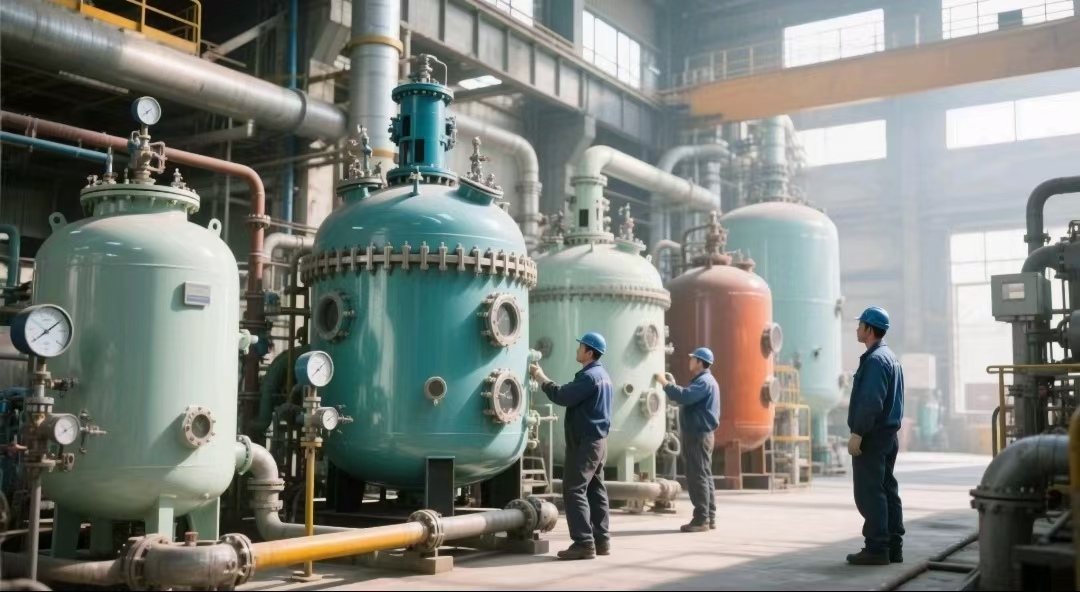
Enamel-lined steel, leveraging the combined advantages of "glass's corrosion resistance" and "metal's strength", plays a crucial role in multiple industrial sectors. Its core application areas are as follows:
1. Chemical and Pharmaceutical Industries
Core equipment manufacturing: Used in reactors, storage tanks, heat exchangers, etc., it can withstand strong corrosive media such as sulfuric acid, hydrochloric acid, and strong alkalis, suitable for high-risk chemical reactions like sulfonation and nitration.
Pharmaceutical processes: In the production of vaccines, antibiotics, and other drugs, it prevents metal ion contamination of materials and meets GMP (Good Manufacturing Practice) cleanliness requirements.
2. Food and Beverage Processing
Food-grade containers: Used in juice concentration tanks, sauce mixing vats, etc., with a smooth surface free of pores, it complies with FDA (Food and Drug Administration) hygiene standards, preventing material flavor contamination or spoilage.
Wine-making and dairy products: For storing wine, milk, and other acidic or high-protein materials, it avoids metal oxidation affecting flavor.
3. Petroleum and Energy Industry
Petroleum refining: In handling sulfur-containing crude oil or acidic oil and gas, such as in desulfurization towers and reactor linings, it resists sulfide corrosion.
New energy sector: In lithium battery electrolyte production, it stores strong corrosive solvents like hydrofluoric acid, ensuring production safety.
4. Environmental Protection and Wastewater Treatment
Wastewater treatment equipment: Used in acid-base neutralization tanks and wastewater storage tanks, it withstands high-concentration pollutant erosion, extending equipment lifespan.
Waste gas treatment: As the lining or piping in desulfurization and denitrification equipment, it resists corrosion from acidic gases like sulfur dioxide and nitrogen oxides.
5. Fine Chemicals and Daily Chemicals
Cosmetics production: In manufacturing reactors for face creams, shampoos, and other raw materials, it prevents metal ions from affecting product stability (such as discoloration or spoilage).
Paints and pigments: For storing solvent-based paints or dye intermediates, it prevents chemical reactions between the container material and the material.
6. Other Special Scenarios
Laboratory equipment: As a metal-reinforced version of glassware like beakers and reaction flasks, it combines corrosion resistance with impact resistance.
Aerospace auxiliary equipment: In special fuel storage, it resists low-temperature or strong oxidant corrosion (such as the lining of rocket fuel storage tanks).
Summary of core advantages:
Corrosion resistance: It has good resistance to most inorganic acids, organic acids, salt solutions, and organic media.
Safety: Its smooth surface does not accumulate scale, preventing material residue from breeding bacteria, meeting hygiene requirements in the food and pharmaceutical industries.
Economy: Compared to all-glass or pure titanium equipment, it is lower in cost and higher in strength, suitable for large-scale industrial applications.