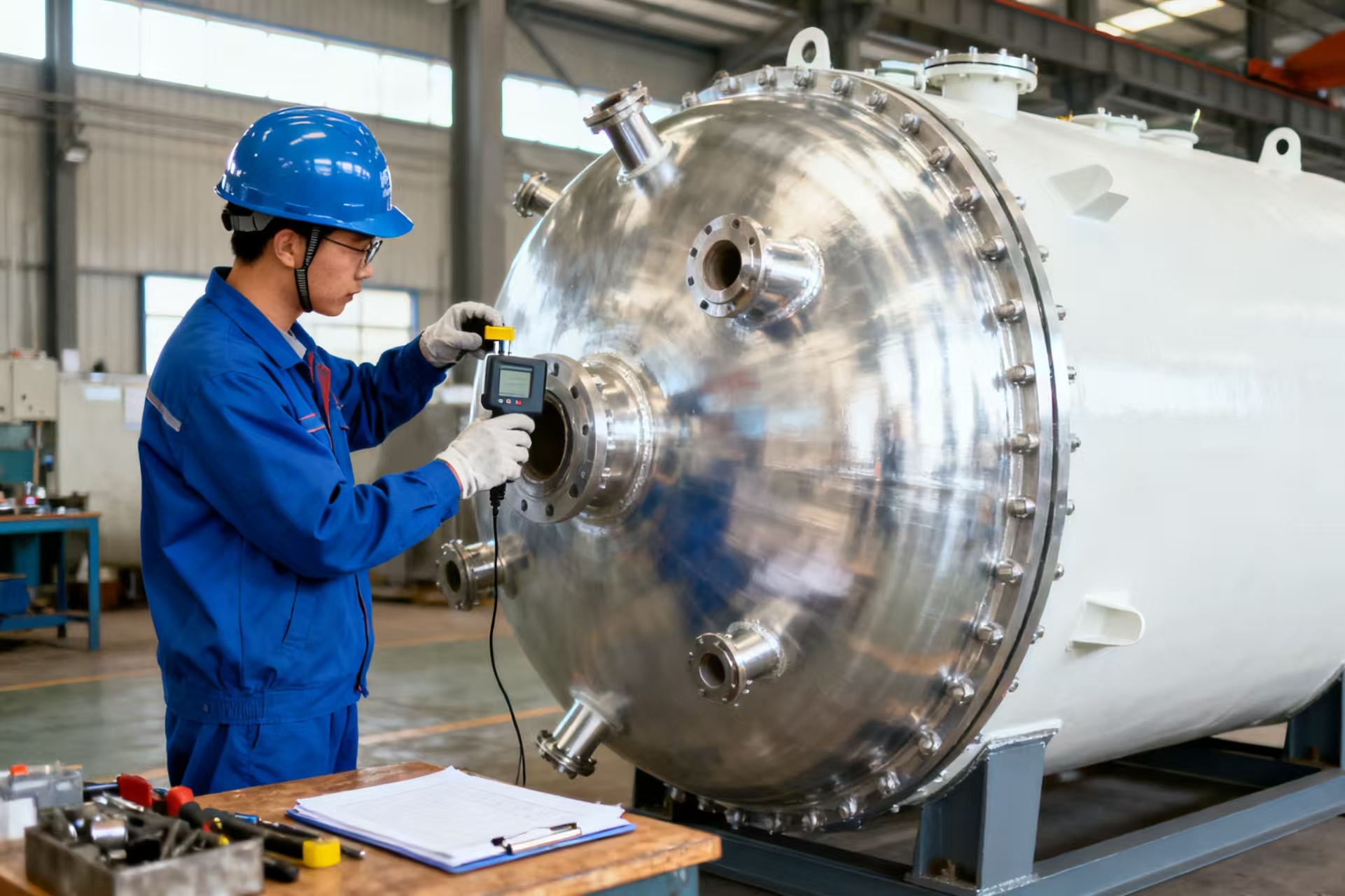
Enamel reactors are essential chemical processing equipment, primarily used for reactions, heating, and storage in industries such as chemical engineering, pharmaceuticals, and food processing. Rigorous pre-delivery inspections
are crucial to ensure their performance, safety, and reliability, which are vital for maintaining production safety and product quality. The following are the standard inspection procedures typically conducted before enamel reactors
leave the factory:
1. Visual inspection: Check whether the enamel reactor is intact, including checking for scratches, cracks, deformation, etc. Ensure that the enamel layer is not falling off and the sealing surface has no signs of leakage.
2. Pressure test: The enamel reactor is subjected to pressure test, including hydrostatic test and pneumatic test, to ensure that it can work normally under the specified pressure without leakage.
3. Mechanical performance test: Check the mechanical performance of the enameled reactor, such as speed, vibration, noise, etc., to ensure that it can run smoothly during the working process and meet the design requirements.
4. Corrosion resistance test: according to the use environment of the enameled reactor, corrosion resistance test is carried out to ensure that it has good corrosion resistance in specific chemical media.
5. Electrical safety test: If the enameled reactor involves the electrical control system, the electrical safety test should be carried out to ensure that the circuit and control system work normally without the potential safety risks such as short circuit and overload.
6. Operation manual and maintenance guide: Provide detailed operation manual and maintenance guide to ensure that users can operate and maintain the enameled reactor correctly and prolong its service life.
7. Factory Inspection Report: Provide a detailed factory inspection report containing test results and conclusions as proof of product quality. Through these inspections, we ensure the enamel reactor meets safety, reliability, and high-performance standards before shipment,
delivering stable and efficient chemical equipment for users in practical applications. This process also demonstrates our strong commitment to user safety and product quality.